
October 1, 2026
Stay in the loop! Join our newletter.


There's a line we come back to often at The Centered Life, and it does more work in twenty words than most explanations do in twenty minutes:
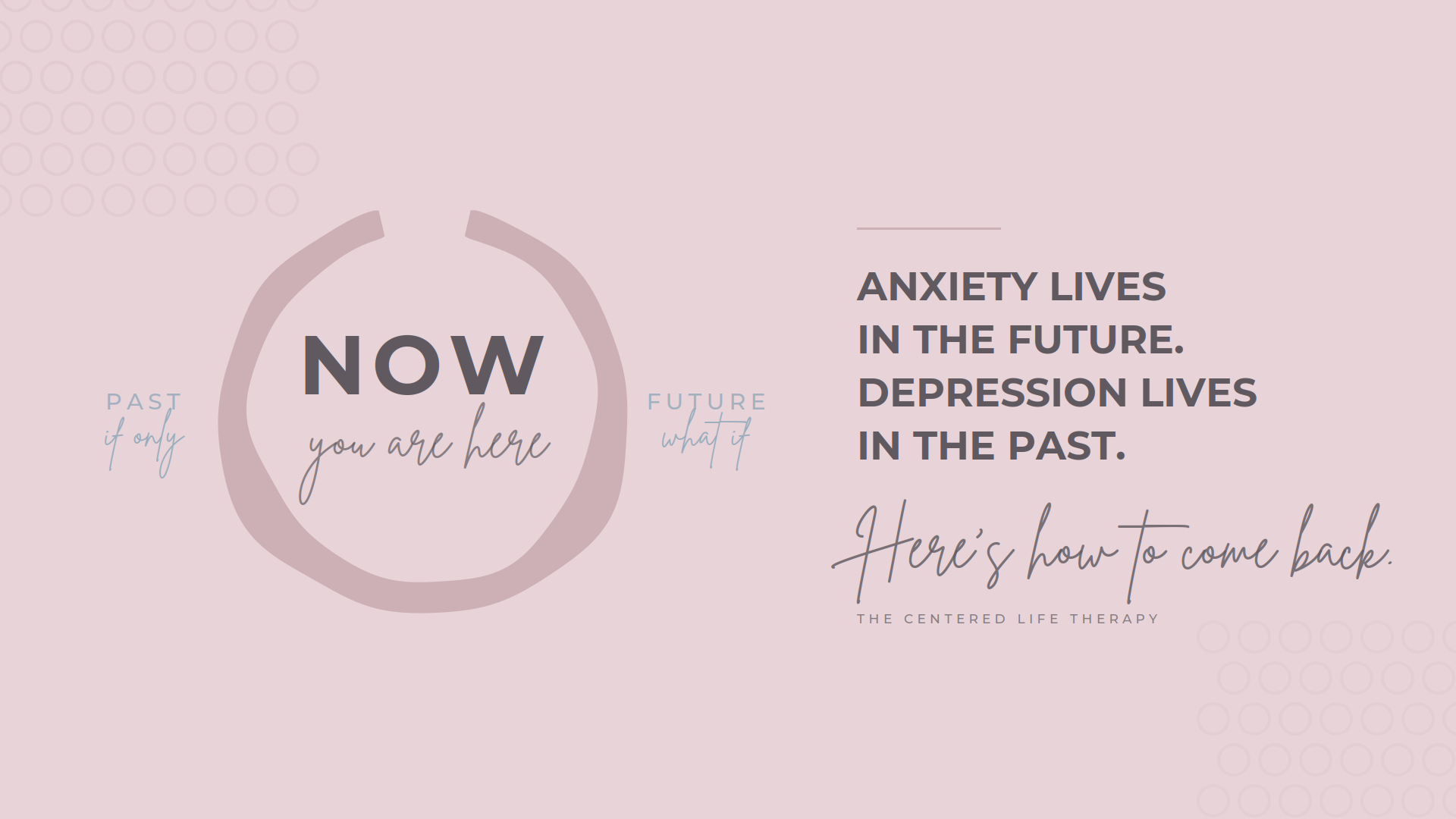
"If you are depressed, you're living in the past. If you're anxious, you're living in the future. If you are at peace, you're living in the present."
The quote is usually attributed to Lao Tzu. Whoever said it first, it describes something we watch happen in our Naperville office nearly every day.
Anxiety pulls you into what if.
What if I said the wrong thing in that meeting. What if the test comes back bad. What if my child doesn't make friends this year. What if I can't keep this up. Anxiety is the mind running simulations of a future that hasn't happened, and it runs them fast, and it almost always runs them dark.
Depression pulls you into if only.
If only I had left sooner. If only I'd been a better parent. If only I were the person I was five years ago. Depression sifts through a past you cannot change, looking for the moment things went wrong, and it never finds a version of the story where you come out well.
Notice what these two have in common. Neither one is happening right now. Both are painful precisely because they're built out of a time you cannot reach — one that already closed, and one that hasn't opened.
Anxiety and depression are not character flaws. They are not weakness, laziness, or a failure of gratitude.
They are two of the most common human experiences there are. Nearly everyone will meet one of them at some point, and many people will meet both. In our work with families across Naperville, Plainfield, Oswego, Downers Grove, and Wheaton, we see them constantly — in high-performing professionals, in devoted parents, in teenagers who look fine on the outside, in people whose lives appear, from the outside, entirely under control.
Feeling anxious does not mean something is wrong with you. It means you're human, and something in your life is asking for attention.
The goal of therapy isn't to delete these feelings. It's to help you stay present through them.
Here's what makes the present moment useful — it isn't that it's always pleasant. Sometimes it isn't.
It's that the present moment is the only place where you have any power at all. You cannot revise yesterday. You cannot control tomorrow. But you can take a breath right now. You can feel your feet on the floor right now. You can decide what happens in the next sixty seconds.
Mindfulness isn't a philosophy you have to adopt. It's a skill you can practice, and like any skill, it gets easier.
The next time you notice your thoughts racing, try this. It works in a car, at a desk, in a bathroom at a family gathering, at 2 a.m.
1. Take one slow, intentional breath.Not ten. One. Make the exhale a little longer than the inhale.
2. Name five things you can see.Out loud or silently. The lamp. The coffee cup. A crack in the ceiling. Your own hands. Whatever is actually in front of you.
3. Notice the sounds around you.Traffic. The refrigerator. Someone in the next room. You aren't judging the sounds, just registering them.
4. Feel your feet on the floor, or your hands in your lap.Press down slightly. Notice temperature, pressure, texture.
5. Gently remind yourself:I am here. I am safe in this moment. I only have to handle this moment.
That's it. You've just moved your attention out of a future that hasn't happened and a past you can't edit, and into the room you're standing in.
This matters, because the word gets misused constantly.
Mindfulness does not mean forcing negative thoughts away. Trying to shove a thought out of your mind reliably makes it louder — this is why "just don't think about it" has never once worked for anyone.
Mindfulness does not mean pretending everything is okay. If something in your life is genuinely hard, naming that honestly is part of the practice, not a violation of it.
What mindfulness actually means is noticing what's happening without judging yourself for it. The thought arrives. You see it. You don't argue with it, and you don't move in with it. You come back to your breath.
You don't have to solve yesterday. You don't have to figure out tomorrow. For this moment, just come back to right now.
Grounding practices are genuinely useful, and they are not a replacement for care.
If anxiety or depression is making it hard to sleep, work, parent, or feel like yourself — if the heaviness has stopped lifting, or the worry has stopped responding to reason — that's worth talking to someone about.
Reaching out to a mental health professional is a strength, not a failure.
You also don't need to be in crisis to start. Many of the people we work with come simply because they're overwhelmed, stretched thin, or ready to feel more grounded in daily life. That's reason enough.
If you or someone you love is in crisis, the 988 Suicide & Crisis Lifeline is available 24/7 — call or text 988.
At The Centered Life Therapy, we work with children, teens, adults, and families across Chicagoland — in person at our new Naperville office and virtually across Illinois. Our therapists offer complimentary consultations, because finding the right fit matters more than finding someone fast.
📍 1750 N. Washington St., Suite 120, Naperville, IL 60563📞 630-315-0021
Congratulations on exploring the first steps to enhancing your life. Let’s chat about you, your family, your job, your stress, your desires, and how we can make joy and bliss in between it all.

.svg)
.svg)